

Website-ready blog draft + SEO implementation notes + developer pre-publish checklist
If you’re planning to invest in paid digital advertising, there’s a good chance you’ve asked this question:
Should my business advertise on Meta or Google?
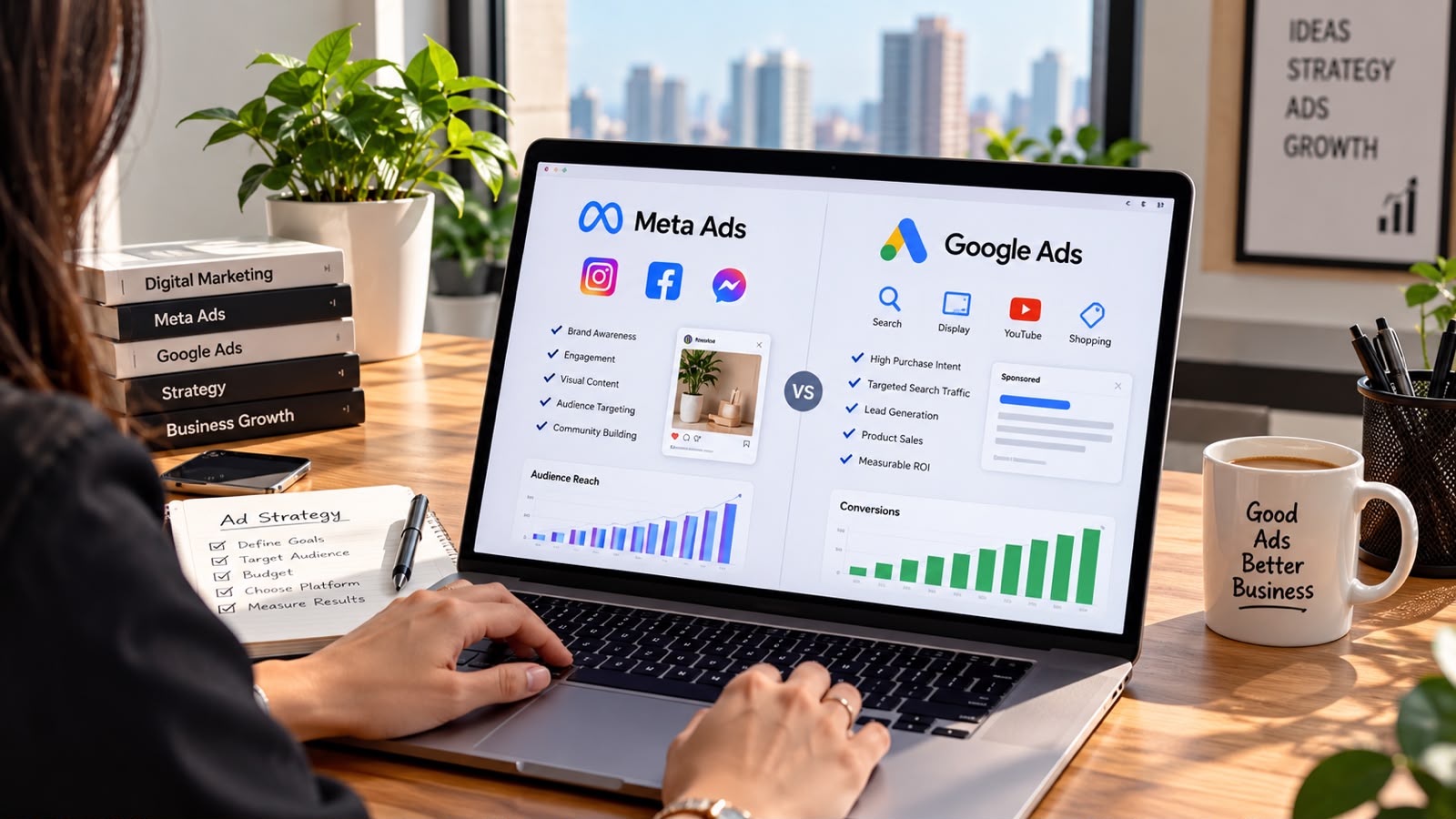
Both platforms can help businesses generate visibility, enquiries and sales, but they work in very different ways. Choosing between them isn’t about deciding which platform is universally better. It’s about understanding where your audience is, what they are doing at that moment and what you want your campaign to achieve.
Let’s break down the difference.
What Are Meta Ads?
Meta Ads are paid advertisements that can appear across platforms in Meta’s advertising ecosystem, most notably Facebook and Instagram.
They are particularly powerful for reaching people based on audiences, interests, behaviours, demographics and engagement signals. Instead of waiting for someone to search for your product or service, Meta allows your brand to appear while people are discovering content.
That makes Meta particularly useful for creating demand, building awareness, generating leads, remarketing and visually showcasing a product or service.
What Are Google Ads?
Google Ads allows businesses to advertise across Google’s ecosystem, including Search, YouTube and other placements.
For many businesses, the biggest attraction is Google Search Ads. These allow your business to appear when someone actively searches for a relevant product, service or solution.
For example, a person searching for “digital marketing agency in Mumbai” is already demonstrating a level of intent. Google Ads can help an agency appear at precisely that stage of the customer’s journey.
This makes Google especially useful for capturing existing demand and high-intent searches.
The Biggest Difference: Discovery vs Intent
One of the easiest ways to understand Meta Ads and Google Search Ads is to look at the mindset of the customer.
Meta Ads: You are often reaching the customer before they actively search for you.
Google Search Ads: You are often reaching the customer because they are already searching for something related to what you offer.
Imagine you run a premium café.
On Instagram, someone might see a beautifully shot Reel featuring your food, ambience or an offer and decide they want to visit. They weren’t necessarily searching for a café at that moment. The creative generated interest.
On Google, someone might search for “vegan cafe near me” or “best cafe in Bandra”. Their intention already exists, and your advertisement is trying to capture it.
Both moments are valuable. They simply occur at different stages of the customer’s decision-making process.
When Do Meta Ads Make Sense?
Meta Ads can be particularly effective when your business benefits from strong visual communication, audience discovery or repeated exposure.
* You want to build awareness for your brand.
* Your product or service can be communicated visually.
* You want to generate leads through forms, WhatsApp or landing pages.
* You want to promote offers, launches, events or new products.
* You want to remarket to people who have previously interacted with your brand.
* You want to test multiple audiences and creative concepts.
Industries such as food and hospitality, fashion, beauty, lifestyle, real estate, education, fitness and many consumer-facing businesses can benefit from Meta’s visual and discovery-led environment.
However, performance still depends on the offer, creative, targeting, landing experience and campaign setup.
When Do Google Ads Make Sense?
Google Search Ads become especially valuable when people are already searching for the service or product you provide.
* Your customers actively search for your service on Google.
* You want to capture high-intent enquiries.
* Your business solves a specific problem or need.
* You operate in a location-based service category.
* You want visibility for commercially relevant keywords.
* You can send users to a strong website or landing page.
Google can be particularly relevant for professional services, local services, healthcare, B2B businesses, education, home services and other categories where customers frequently begin their buying journey with a search.
Which Platform Is Better for Lead Generation?
Both Meta and Google can generate leads. The quality and cost of those leads depend on far more than the platform itself.
Meta may help you reach a larger audience and create demand efficiently, while Google Search may allow you to reach fewer people who are demonstrating stronger immediate intent.
But a Google lead isn’t automatically better, and a Meta lead isn’t automatically cheaper.
Lead quality can be influenced by:
* Your offer
* Audience targeting
* Keywords and search terms
* Ad creative and messaging
* Landing page or lead form
* Geography
* Pricing
* Follow-up speed
* Sales process
A campaign can generate excellent leads and still appear unsuccessful if those enquiries aren’t followed up properly. Paid advertising and sales conversion need to work together.
What About the Advertising Budget?
There is no universal minimum budget that works for every business.
A local business targeting a small geographic area has different requirements from an e-commerce brand advertising nationally. Competitive keywords on Google can also require a very different budget from a Meta campaign focused on awareness or remarketing.
Rather than dividing your budget equally between platforms by default, start with your business objective and customer journey.
Your budget should follow the strategy, not the other way around.
Can You Use Meta Ads and Google Ads Together?
Yes, and for many businesses this can create a stronger marketing ecosystem.
Meta can introduce your brand to potential customers and keep it visible through engaging content and remarketing. Google can then capture people when they actively search for your brand, category, product or service.
A customer journey could look something like this:
Instagram Reel → Website Visit → Remarketing Ad → Google Search → Enquiry
Marketing rarely happens in one perfectly straight line. Customers may encounter a business several times before taking action.
Don’t Judge a Platform Only by Cost Per Lead
Cost per lead is important, but it shouldn’t be viewed in isolation.
Imagine Campaign A generates 100 leads at Rs. 200 each, while Campaign B generates 40 leads at Rs. 400 each. Campaign A appears better at first glance.
But if Campaign B produces significantly more qualified conversations and actual customers, its higher cost per lead may still make commercial sense.
Where possible, businesses should look beyond surface-level advertising metrics and connect campaigns to meaningful outcomes such as qualified leads, appointments, bookings, purchases or revenue.
Creative Matters More on Meta Than Many Businesses Realise
On Meta, your advertisement competes with Reels, memes, creators, friends, brands and an endless stream of content.
Targeting matters, but your creative is often what earns the first second of attention.
The hook, visual, format, copy, offer and call-to-action can all influence campaign performance. This is why performance marketing shouldn’t be completely separated from content and design.
Good media buying can distribute an advertisement. Good creative gives people a reason to notice it.
So, Meta Ads or Google Ads?
The right answer depends on what your business is trying to achieve.
Consider Meta Ads when: you want discovery, awareness, visual storytelling, lead generation or remarketing.
Consider Google Ads when: customers are actively searching for your service, product or solution and you want to capture that intent.
Consider both when: you want to build demand and capture demand across different stages of the customer journey.
Instead of asking “Which platform is better?”, a more useful question is:
“Where is my customer in their decision-making journey, and which platform helps me reach them at that moment?”
How Panjosocial Approaches Paid Advertising
At Panjosocial, we don’t believe every business should run the same advertising strategy.
Before deciding where to advertise, we look at the business, audience, objective, creative requirements, geography, budget and customer journey.
Our approach brings together content, design creativity, Meta advertising, Google advertising and AI-assisted research and optimisation to build campaigns around what the business actually needs.
Because choosing an advertising platform is only the beginning. The real work is making the platform, creative, targeting and business objective work together.
Planning to Run Meta or Google Ads?
If you’re unsure which platform makes sense for your business, talk to Panjosocial.
We’ll understand your objectives and help you identify a digital advertising approach suited to your brand, audience and budget.
Your Brand, Our Vision.