
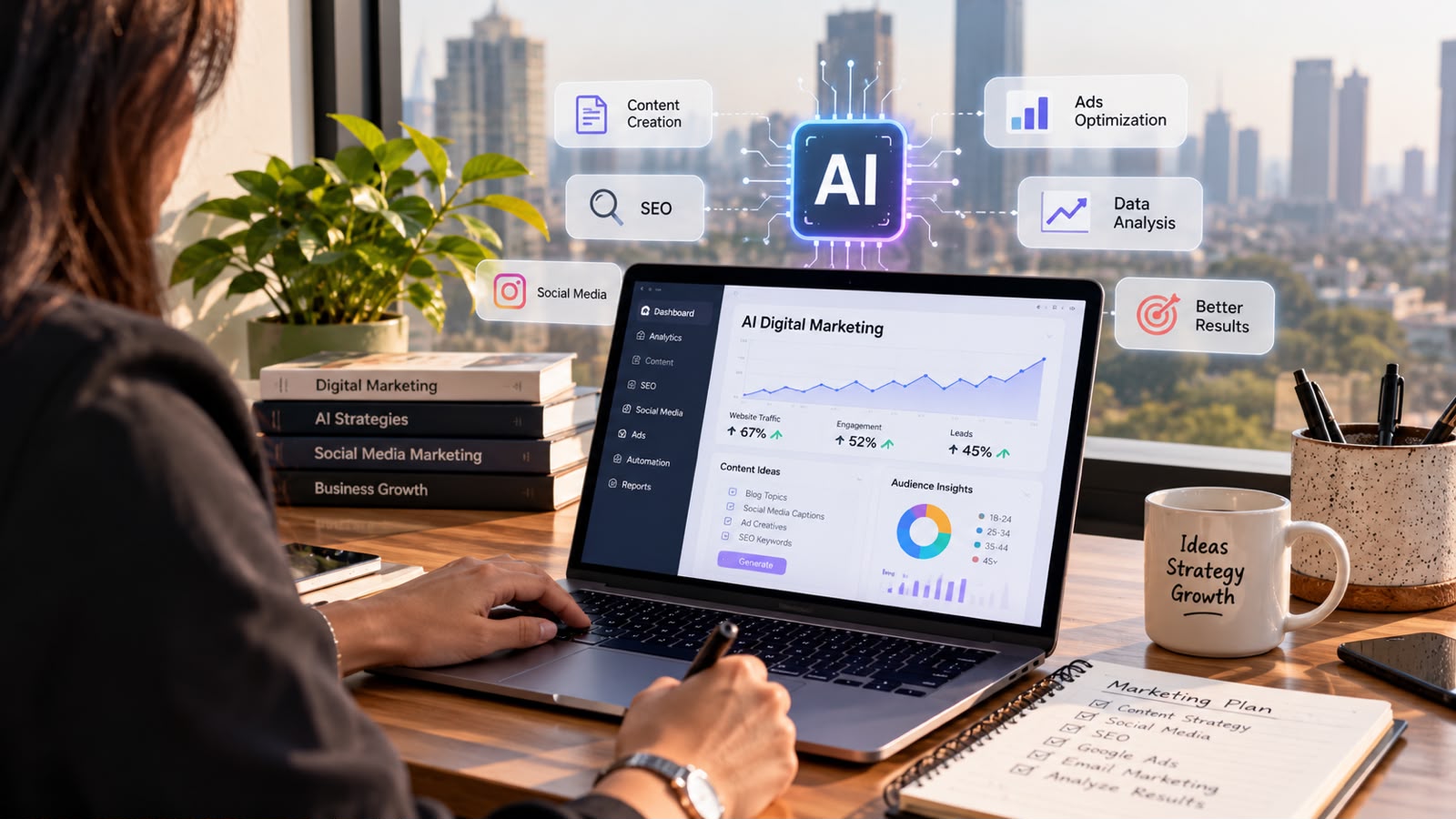
Artificial Intelligence is no longer something marketers are simply experimenting with. It has become part of how campaigns are researched, created, analysed and optimised.
But that doesn’t mean AI has replaced marketers, designers or creative thinking.
For businesses, the real opportunity lies in understanding where AI can make marketing faster and smarter, and where human judgement still matters.
At Panjosocial, we see AI as a tool that can strengthen the creative and strategic process rather than replace it.
So what is actually changing?
1. Content Ideation Is Becoming Faster
One of AI’s most practical uses in marketing is research and ideation.
Marketing teams can use AI-assisted tools to explore customer questions, campaign angles, content themes, competitor positioning and different ways of communicating an idea.
This can reduce the time spent staring at a blank page. But generating 100 ideas isn’t the same as identifying the right idea.
AI can expand the idea pool. Human judgement decides which idea deserves to become a campaign.
2. AI-Assisted Artwork Is Changing the Creative Process
AI image generation and editing tools have opened new possibilities for brands that need distinctive visual content.
They can assist with concept visualisation, backgrounds, creative compositions, mood exploration and campaign artwork. For an agency, this means some concepts that once required lengthy production can now be explored much earlier in the creative process.
The challenge is consistency.
An AI-generated visual can look impressive and still be completely wrong for the brand. Colours, typography, product details, logos, proportions and the overall visual language need creative direction.
For Panjosocial, AI artwork is most useful when it works within a brand system, not when it becomes the brand system.
3. AI Video Creation Is Expanding What’s Possible
Video remains one of the most important formats across digital platforms, and AI is changing how video content can be conceptualised and produced.
AI-assisted workflows can help with visual concepts, storyboarding, generated scenes, editing support, variations and content adaptation.
For businesses, that can create opportunities to produce ideas that might otherwise require larger production resources.
But the technology doesn’t automatically create a good Reel, advertisement or brand film. The concept, hook, pacing, brand relevance and message still determine whether people care enough to watch.
4. Research & Analysis Can Become More Efficient
Marketing involves a surprising amount of information: customer behaviour, campaign reports, competitor activity, content performance, search trends and audience feedback.
AI can assist marketers in organising information, identifying patterns and summarising large amounts of data more efficiently.
That can give teams more time to focus on the important question: what should we do with what we’ve learned?
AI can help surface patterns. Strategy still requires context.
5. Meta & Google Advertising Are Becoming More AI-Assisted
Advertising platforms have increasingly incorporated automation and machine learning into campaign delivery, audience discovery, bidding, creative combinations and optimisation.
For marketers, the job is therefore changing from manually controlling every variable to giving advertising systems better inputs and making better strategic decisions around them.
Those inputs can include:
* A clear campaign objective
* Strong first-party business information where available
* Relevant audience and geographic signals
* High-quality creative variations
* Compelling offers and messaging
* Accurate conversion tracking
* Enough data and time to learn
AI-assisted optimisation doesn’t mean campaigns should be left unattended. Businesses still need to understand lead quality, profitability, customer behaviour and whether the platform is optimising toward an outcome that actually matters.
6. Personalisation Is Becoming Easier to Scale
Different customers respond to different messages. AI can help marketers create and test more variations of headlines, visuals, formats and communication for different audiences.
This doesn’t mean every customer needs an individually generated advertisement. It means brands can become more thoughtful about matching the right message to the right context without multiplying production time endlessly.
7. AI Is Changing SEO Too
Search is evolving as AI becomes more integrated into how people discover and understand information online.
For businesses, this makes useful, clearly structured and genuinely knowledgeable website content even more important.
Publishing dozens of generic AI-written articles isn’t a shortcut to sustainable visibility. Brands need content that answers real customer questions and adds experience, examples, expertise or perspective that generic content cannot.
AI can assist with research, structure and optimisation, but the final content should still sound like the business knows what it is talking about.
What AI Can Do vs What Still Needs Human Thinking
AI can help with:
* Research and information organisation
* Brainstorming and content ideation
* Creative variations
* AI-assisted artwork and video workflows
* Copy variations and first drafts
* Data analysis and pattern identification
* Campaign optimisation support
* Repetitive production tasks
Human thinking remains critical for:
* Brand positioning
* Taste and creative direction
* Understanding cultural and customer context
* Knowing what should not be communicated
* Original campaign thinking
* Client relationships and business understanding
* Interpreting commercial outcomes
* Making strategic decisions
The strongest marketing teams won’t necessarily be the ones using the most AI. They’ll be the ones who know when to use it.
Will AI Replace Digital Marketing Agencies?
AI is changing what clients should expect from agencies.
Tasks that can be completed faster with technology should become faster. Research can become deeper. Creative exploration can become broader. Campaign teams can analyse more information.
But businesses don’t hire an agency merely to operate software.
They hire an agency to understand their business, identify opportunities, develop ideas, make decisions, execute consistently and ultimately help marketing contribute to growth.
AI changes the toolkit. It doesn’t remove the need for thinking.
How Panjosocial Uses AI
At Panjosocial, we are integrating AI into our creative and digital marketing capabilities while keeping strategy and human creativity at the centre.
Our AI-assisted capabilities include:
* AI-assisted video creation
* AI artwork and visual exploration
* Research and analysis
* Content ideation and development
* Creative experimentation
* AI-assisted Meta Ads optimisation
* AI-assisted Google Ads optimisation
The objective isn’t to use AI because it sounds futuristic. It’s to use technology where it can genuinely improve the quality, speed or intelligence of the work.
Human creativity. Smarter tools. Better possibilities.
What Should Businesses Do Next?
Businesses don’t need to rebuild their entire marketing strategy around AI overnight.
Start by identifying where your marketing team spends unnecessary time, where more information would improve decisions and where technology could expand creative possibilities.
Then introduce AI with a clear purpose.
The brands that benefit most won’t be the ones chasing every new AI tool. They’ll be the ones using the right tools to solve real marketing problems.
Want to Explore AI-Powered Marketing for Your Brand?
If you’re curious about how AI can be practically incorporated into your content, creative production or advertising, talk to Panjosocial.
We’ll help you explore where AI makes sense for your brand and where human creativity should continue to lead.
Your Brand, Our Vision.